A Coat of Arms Is Not a Community Portrait
A coat of arms can explain a civic institution without depicting every resident. Learn how to read its symbols, limits and public meaning.
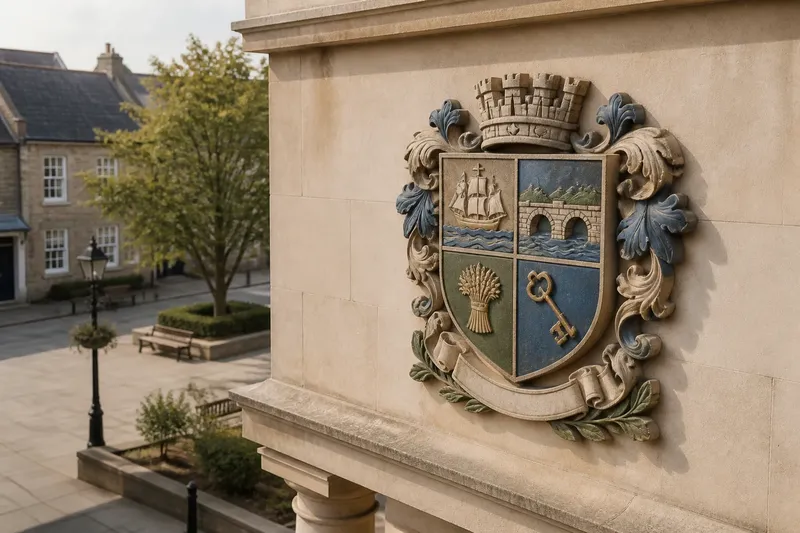
A coat of arms can explain what a civic institution stands for, but it cannot portray everyone who lives under its authority. The same is true of a town seal: its compact images and formal wording represent a body of government, not a complete account of the community’s people, experiences or disagreements.
That distinction matters when a heraldic device appears on a council chamber, a public document or a street sign. A symbol may be meaningful and worth preserving while still leaving important stories outside its frame. Reading it well means asking both what it says and what kind of claim it is able to make.
What does a coat of arms represent?
A coat of arms is a formal visual identifier associated with a person, family, institution or place. A civic coat of arms generally identifies a local authority or civic body. Its shield, colours, figures and motto can communicate recognised associations, such as a local trade, landscape, historical connection or institutional role.
A seal has a related but distinct purpose. It is an official mark used to authenticate or identify documents and actions. Some seals incorporate a shield or other heraldic elements, while others use a different design. In everyday speech, people may call either one a town’s “crest”, but the correct name depends on the object and the institution’s own usage.
These devices compress meaning into a small, repeatable form. That makes them useful on letterheads, plaques and official signs, where a lengthy explanation would not fit. It also makes them selective: a designer cannot include every resident, neighbourhood, memory or point of view in one shield.
Start by identifying the institution the arms belong to, rather than assuming they describe the whole population.
How should you read the images and colours?
Read the design first as a set of visible features, then as an interpretation. A ship, bridge, tool, animal or plant may point towards a place, an activity, a local story or an inherited convention. Colours and shapes may also carry heraldic meaning, but a familiar image does not have one universal meaning across every civic emblem.
Look for the official description, often called a blazon, if one is available. A blazon is a formal verbal account of a coat of arms that specifies its components and arrangement. It can help distinguish an intended feature from a modern artist’s stylistic choice, particularly when the same arms appear in different forms on stone, paper or digital displays.
Then separate what is visible from what you infer. A mill wheel may suggest a connection to milling, but the image alone does not tell you who worked there, who owned the mill or how its products shaped local life. Those questions require evidence beyond the emblem.
Imagine a council seal showing a river, a key and a small vessel. You can describe those elements and check whether the council identifies them as local references. You should not conclude from the picture alone that the river mattered equally to every neighbourhood or that the vessel represents every resident’s livelihood.
Why can’t a civic coat of arms represent everyone?
Because a civic emblem represents through selection, not through a census of identities. Its purpose is to identify an institution or place in a concise, recognisable form. Even a design created with care can only foreground a limited number of associations, and those associations may reflect the priorities, knowledge and conventions of the people who chose them.
That does not make the emblem false. It means its claim is narrower than a portrait of the community. A coat of arms can stand for a council in an official setting without suggesting that every resident feels equally represented by its imagery.
There may also be a difference between institutional continuity and lived experience. An emblem can remain in use while the population changes, local industries shift and public understanding of the past develops. The symbol’s continued presence tells you something about civic identity and official practice; it does not, on its own, tell you how residents interpret it now.
So when someone asks whether the arms “represent the town”, clarify the sense of representation. They may represent the municipal authority, serve as a shared identifier, or express a preferred account of local identity. Those are connected ideas, but they are not interchangeable.
What stories can a shield leave out?
A small design tends to privilege what can be turned into a clear image. A harbour, crop, craft or prominent building can be shown more readily than the daily work, migration, care, conflict and cultural exchange that also shape a place. Those less easily pictured experiences may be absent without being unimportant.
Omission is not proof of deliberate exclusion. Some symbols were adopted for practical or inherited reasons; others were chosen to express a particular civic narrative. To understand the difference, look for records of the design’s adoption and later interpretation, rather than treating the image as self-explanatory.
Ask who selected the symbols, what reasons were recorded, and whether the institution has explained them in accessible language. A museum label, council history page or archive catalogue may provide useful context. If accounts disagree, that disagreement can itself help show that civic meaning is debated rather than fixed.
It is also worth noticing what the emblem does not claim. A shield may identify a council without claiming to show all the communities governed by it. Reading carefully avoids turning a visual shorthand into a complete social history.
Where do civic arms and seals appear?
Look for civic arms on council stationery, formal notices, boundary markers, building plaques, ceremonial objects and public-facing signs. A seal may appear on documents where authentication matters, while a coat of arms may be used more broadly as an institutional identifier. A local authority may also use a simplified logo for routine communication alongside its formal arms.
The setting affects how people encounter the design. On an official document, it can signal the issuing body. On a historic object, it may help identify who commissioned or owned it. On a public building, it can connect the present institution with an established civic identity. None of these uses turns the image into a complete account of local life.
When studying an emblem in place, note its surroundings as well as its details: what institution displays it, what text accompanies it and who is likely to see it. A coat of arms on a council entrance makes a different statement from the same design in a museum display explaining its history.
How can a community explain an emblem’s limits?
Good interpretation names both the emblem’s purpose and the limits of its reach. A short caption can identify the authority represented, describe the principal devices in plain language and state that the image is a civic identifier rather than a portrait of all residents. This adds context without requiring the symbol to carry more meaning than it can bear.
Institutions can also place the arms alongside other sources of local memory. Oral histories, photographs, maps, objects and personal accounts can make visible experiences that a formal shield cannot contain. The point is not to replace one symbol with a crowded collection, but to avoid treating one official design as the whole record.
Imagine a library preparing a display around its council’s arms. Staff could label the shield’s visible elements, cite the council’s stated interpretation and invite visitors to explore nearby records about different neighbourhoods and occupations. The expected result is a display that explains the emblem while giving visitors other ways to understand the place.
Public interpretation should not imply that every resident shares one view. Clear wording can distinguish the institution’s account from the range of responses people may have to it.
What do readers often ask about civic arms?
Is a coat of arms the same as a town logo?
No. A coat of arms follows heraldic conventions and may have a formal description, while a logo is a graphic identifier that can be designed more freely. A council may use both, assigning them different roles in official and everyday communication.
Does a town seal prove that a story on it is true?
No. The seal identifies or authenticates an institutional act; its imagery is not independent evidence for every historical interpretation attached to it. Check documentary records and reliable local interpretation before treating a visual feature as proof of a particular event.
Who decides what appears on civic arms?
The answer depends on the emblem’s history and the authority responsible for it. Adoption records and official descriptions can clarify who proposed or approved the design and what reasons were given.
Can an institution change how it explains its arms?
It can provide fuller interpretation without changing the design, for example through a plaque, catalogue entry or public information page. Changes to the arms themselves may involve formal procedures, so the relevant authority’s rules should be checked.
How can you describe a coat of arms accurately?
Begin with a neutral description: name the visible objects, colours and arrangement without assigning motives. Then identify the institution and consult its official wording or a reliable local record. If the meaning remains uncertain, say so rather than presenting a guess as established fact.
Next, distinguish the emblem’s intended meaning from its present reception. An official explanation tells you how the institution describes the design; it does not establish that every resident reads it the same way. Where relevant, mention that a civic symbol can be valued, questioned or simply regarded as an administrative mark.
Finally, connect the image to wider civic memory without asking it to stand in for that memory. A coat of arms may open a useful conversation about local identity, but it is only one object within a much larger record. The phrase civic coat of arms is most accurate when it names that institutional role while leaving room for the people and stories beyond the shield.