Why Civic Buildings Put the Entrance Where They Do
Why civic buildings put the entrance where they do: assess the route, signs, thresholds and accessible paths to see how visitors find their way in.
Why civic buildings put the entrance where they do becomes clear when you follow the approach on foot: the door may face a main street, sit beneath a tower or turn towards a quieter path. Its location affects how visitors find the public way in and how the building meets its surroundings.
How does the entrance meet the route people take?
A civic building often stands near streets, paths or public transport. Placing its entrance beside a familiar walking route can make arrival direct: visitors approach without circling the building or guessing which side is public. A council office beside a pavement, for example, may face the street so that someone seeking a service can spot the doorway from the route.
The busiest edge is not always the most useful one. A noisy road may run along the building’s formal frontage while a quieter pedestrian path reaches another side. In that case, an entrance facing the path can serve everyday movement better than a prominent door facing traffic.
To assess the whole approach, start at the point where a visitor first reaches the site and follow the route to the door. Check each item below; the result should guide a practical decision rather than a judgement based on appearance alone.
- Observe whether a continuous pavement or path reaches the public door; if it does, follow it, but if it stops or becomes ambiguous, identify a clearer route before continuing.
- Observe whether signs point to the public entrance before a visitor reaches a choice of paths; if they do, follow their direction, but if they do not, consult the building’s current visitor information rather than guessing.
- Observe whether a vehicle entrance, fence or delivery area interrupts the walking route; if it does not, continue towards the door, but if it does, look for a marked pedestrian route around it.
- Observe whether the public door is distinguishable from staff and service doors; if it is, use it, but if the doors appear alike, check signs or visitor information before trying a handle.
- Observe whether steps are the only visible way to the entrance; if a level route is clearly marked, follow it, but if no such route is apparent, check the building’s access information or ask staff for directions.
- Observe whether there is a sheltered place to pause and read signs without blocking the path; if there is, stop there, but if there is not, move to a safe clear spot before checking directions.
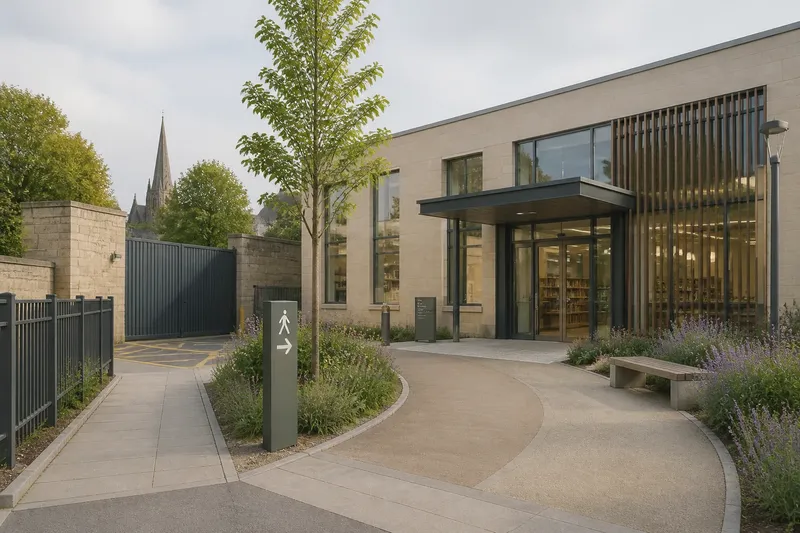
Say you are approaching an invented town library from a pavement that forks beside a delivery gate. You see a sign pointing to the public entrance along the quieter branch, a continuous path and a level doorway marked with a canopy. Following that branch takes you to the public door without crossing the delivery area; if the sign were absent, the sensible decision would be to check the library’s visitor information rather than assume the delivery gate leads inside.
What makes the public door recognisable?
Large buildings may have public entrances, staff doors, delivery bays and emergency exits on the same façade. A main entrance is easier to identify when a sign, canopy, lighting, paving or view into the lobby distinguishes it from service access. These cues can be modest; the important point is that they work together rather than competing.
A sign is most useful before a visitor reaches the door. A glimpse of reception through glass can confirm that the route leads to a public interior, while a sheltered place nearby gives someone time to read directions. If the only sign appears beside the handle, visitors may have already chosen the wrong door or turned away.
Distinctive materials can help identify an entrance, but appearance alone is not enough. A grand stone surround does not tell a visitor whether a door is open to the public; clear signs and a continuous approach do.
When does visibility help, and when does it expose?
A visible entrance can reassure visitors that the building is active. A view towards a lobby or reception helps explain what lies beyond the door, and staff may be better placed to notice someone who needs assistance.
More glass is not always the answer. A civic building may need privacy for conversations about personal matters, or a calmer interior away from traffic and glare. A vestibule—an enclosed space between outdoors and the main interior—can provide a gradual transition while still making the next direction clear.
From outside, notice whether you can see a reception area, directory or waiting space, or whether reflections obscure the interior. That view helps explain whether the entrance emphasises orientation, discretion or a formal first impression.
How does the threshold affect arrival?
The threshold is the point where outside conditions give way to the interior. A flush doorway makes that transition immediate; a porch, deep recess or heavy door can slow the pace and offer shelter. The same features can make entry feel more demanding if the route is unclear or the door is difficult to use.
Changes in level need particular attention. Steps may make a doorway prominent, but they are not usable by everyone. A ramp or level entrance should be visible and lead naturally to the same public interior. If it is hidden around a side wall, visitors may read it as a secondary route, even when it reaches the same lobby.
Stone, timber and glass also shape expectations. Stone may suggest permanence, timber a more domestic character, and glass an active interior. These impressions depend on context, and practical signs of access matter more than material symbolism.
What does the entrance say about civic use?
A centred doorway on a balanced façade can give a building a formal presence. An entrance set to one side may respond to the site or a pedestrian route, though it can leave visitors uncertain if the path and signs do not make its position clear. A projecting porch can offer shelter; a recessed door can create a protected place to wait.
Scale also sets expectations. A monumental entrance may suit a hall used for public gatherings, but feel imposing at a building people visit for routine services. A smaller door can feel more approachable if it remains visible and is not lost beneath a larger façade.
Look for a fit between the entrance and the building’s daily purpose. Civic dignity need not make ordinary visitors feel that they require special permission to enter.
What do readers ask about civic building entrances?
Why is the main entrance sometimes not centred?
The door may face a pedestrian route, respond to the shape of the site or turn away from traffic. An off-centre entrance works best when the path and signs make its position easy to understand.
What makes a public entrance easy to recognise?
A continuous route, a sign visible before the doorway and a clear distinction from service doors help visitors choose correctly. A canopy or view into reception can reinforce those cues.
Does a grand entrance always feel welcoming?
No. A formal surround can express civic importance, while barriers, an unclear route or a hard-to-find door can make arrival uncertain. The experience depends on how the entrance works as well as how it looks.
How can visitors identify an accessible route?
Look for a clearly marked level route that leads to the same public interior as the main approach. If its location or availability is unclear, check the building’s current visitor information rather than relying on appearance alone.
How can you read the approach as part of the building?
Follow the route from the pavement to the first public room. Notice where it branches, which signs appear before each choice and whether the next destination is apparent after the door opens. This connects the entrance’s design to the practical experience of arriving.
Why civic buildings put the entrance where they do is often best understood through that route: a door’s position can serve pedestrians, signal public access or create a more formal threshold. When the access arrangements remain unclear, use current visitor information instead of guessing from the building’s façade.