Statue or Empty Plinth: Two Ways to Remember in Public
Statue or empty plinth? Compare what each form asks a community to remember, whose presence it makes visible, and how visitors can interpret the choice.
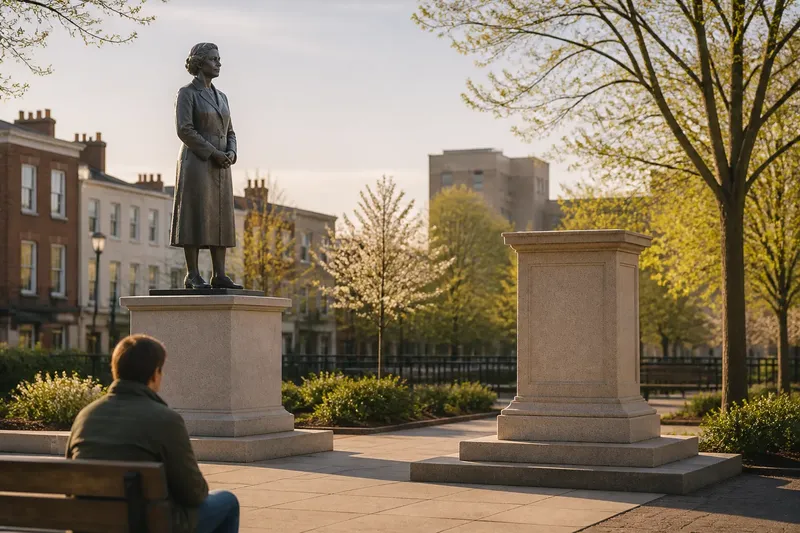
A statue or empty plinth makes a different claim about public remembrance before anyone reads its inscription. A statue gives a person or figure a visible body; an empty plinth makes absence itself part of the memorial. If you are weighing these forms for a shared place, begin with the memory the community wants to hold, not with a preference for a finished object.
What should the memorial help people remember?
Write down the memory in plain language. It might concern a particular person, a group’s experience, a loss, an act of public service or an unresolved dispute. Separate what is known from what is interpreted: a memorial can honour someone, record an event, mark grief or invite questions, but those purposes are not interchangeable.
A figurative statue suits remembrance centred on a person or a recognisable human presence. A face, posture, clothing or gesture can suggest a role and offer visitors a point of attention. Yet the image also selects: it gives one body prominence and can make a complicated history appear settled or singular.
An intentionally empty plinth can hold attention on what is missing, contested or not easily represented by one figure. Its emptiness is not self-explanatory, however. Without clear interpretation, visitors may read it as unfinished work, neglect or an invitation to imagine a replacement.
Write a one-sentence purpose that does not prescribe a single reaction. That sentence will help distinguish remembrance from a demand for admiration.
Whose presence would each form place in view?
Before choosing a form, ask who is being remembered, who has been left out of the public story, and who is likely to encounter the memorial. A statue can make an overlooked person visibly present, but a likeness may raise questions about consent, accuracy or the way a person’s life is represented. An empty plinth can avoid claiming to speak for someone, while still making the space around that absence meaningful.
Consider the setting as well as the subject. A figure raised above street level may communicate authority; a lower, more approachable sculpture can suggest a different relationship with passers-by. An empty base beside a busy path may feel like a deliberate pause, while one in a secluded corner may be overlooked. The same form can carry different meanings in different surroundings.
Imagine a neighbourhood considering a memorial to residents displaced by a redevelopment. If the group wants visitors to encounter a particular resident’s documented story, it might consider a statue alongside a careful inscription. If it wants to mark the many lives that cannot be represented by a single portrait, it might retain an empty plinth and explain whose absence it signifies. In either case, the expected result is a clearer prompt for reflection, not a single agreed interpretation.
What can visitors understand without explanation?
Test the proposal by describing what a passer-by can see from the approach, at close range and from a seat or accessible route. A statue may be legible from a distance, but its expression and details may disappear without a path that allows closer viewing. An empty plinth can be visually simple, yet its meaning may depend more heavily on words, placement and context.
Plan interpretation as part of the memorial rather than as a later patch. An inscription can identify the subject and explain why the form is used. A nearby panel or a carefully maintained online record can provide fuller context, including differing views, without crowding the object itself. Make sure the basic meaning is available to someone who does not already know local history.
For an empty plinth, say directly why it is empty and whether that condition is intended to continue. For a statue, explain why this person or representation has been chosen and what the work does not claim to represent. Clear wording need not settle disagreement; it should give visitors enough information to understand what they are looking at.
How will the choice change over time?
A public memorial is encountered by people whose knowledge and relationship to its subject may change. Ask how the community can revisit its interpretation, and who is responsible for keeping the memorial legible and cared for. A statue may attract new readings as its subject is reconsidered. An empty plinth may prompt debate about whether absence remains the right expression or has become too obscure.
Decide what can change without erasing the original decision. A dated interpretation panel can be updated while the sculpture remains in place; an empty plinth can retain its form while its accompanying explanation records changing views. If the memorial is intended as a temporary pause before another decision, state that plainly and explain how the next discussion will happen.
Practical matters matter too: surface, weathering, cleaning, lighting, sightlines and access affect whether people can encounter the memorial as intended. These choices should be considered alongside the meaning, not used as substitutes for it. For permissions, conservation needs or accessibility requirements, check the relevant local rules and consult qualified specialists where appropriate.
Which form answers the real question?
Use these questions to compare proposals without treating either form as the default:
- Is a particular person central to the memory? If so, consider whether a figure can represent that person responsibly, rather than turning them into a stand-in for everyone.
- Does the memorial need to mark a loss or an unresolved absence? If so, an empty plinth may express that condition, provided its meaning is explained.
- Will visitors understand the choice at the site? If not, revise the inscription, setting or interpretation before approving the design.
- Can the community care for and revisit the memorial? If not, reconsider the material, responsibilities or process for future interpretation.
For statue or empty plinth, the useful decision is not which object looks more complete. It is which form makes the intended memory visible without pretending that one image, one absence or one inscription can speak for an entire community.
Before a final choice, ask someone unfamiliar with the proposal to describe what they think the memorial is saying after seeing the design and its wording. Their reading can reveal whether the intended meaning is present in the place itself, rather than only in the minds of those who planned it.