A Small Plan for Looking at a Civic Ceremony
A civic ceremony becomes easier to understand when you follow its sequence, repeated gestures and use of space instead of decoding every symbol at once.
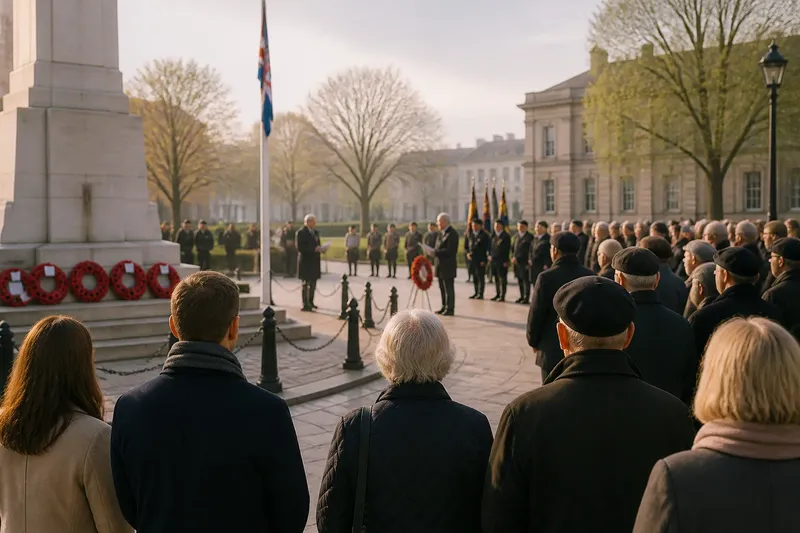
At a civic ceremony, the moment everyone turns towards a flag, memorial or speaker is often more revealing than the object itself. A civic ceremony makes sense as an occasion: watch what happens, who takes part, and how people use the space before trying to interpret every sign.
This approach is useful at a remembrance gathering, a civic welcome, a public commemoration or a formal opening. It does not require specialist knowledge or a complete programme. It asks you to follow three things: sequence, repeated gestures and the arrangement of people in place.
Why follow the occasion before interpreting its symbols?
A ceremony is not simply a collection of objects and words. It is an ordered event in which people arrive, gather, act and disperse. The order can give a symbol its immediate meaning: a wreath, for instance, may be presented after a speech, while a silence may come before a communal song.
Trying to identify every emblem or infer a single shared belief can distract from these observable relationships. Instead, begin with what a person nearby could also see: who enters first, where attention shifts, which actions recur, and what marks the end of one part and the start of another.
Keep interpretation provisional. A repeated gesture may signal respect, participation or formal procedure; the sequence can suggest which possibility fits, but it may not settle the matter completely.
How can you trace the sequence?
Think of the ceremony as a chain of transitions rather than a list of highlights. Notice how the gathering begins, what changes the group’s attention, and how people move from one part to the next. A bell, an announcement, a procession or a pause can serve as a boundary between moments.
You can follow this simple pattern without writing anything down:
- Arrival: Who is already present, and who comes in later?
- Gathering: Where do people settle, and what draws their attention?
- Central action: What action appears to organise the occasion?
- Response: Do others watch, speak, sing, stand, bow or join in?
- Release: What signals that the formal part has ended?
The pattern is a prompt, not a rigid template. Some ceremonies begin informally, and others have overlapping sections. If you lose track, choose one transition to watch closely rather than trying to reconstruct everything at once.
Say you arrive at a civic remembrance gathering while people are taking their places. You notice that a spoken address is followed by a pause, then a collective song, and finally a procession away from the memorial. That sequence gives you a clear account of how the occasion develops, even if you do not recognise the song or know why the procession follows that route.
What do repeated gestures tell you?
A gesture becomes easier to read when you notice whether it is repeated, shared or reserved for particular participants. Standing together may invite a collective response; a person laying an object down may mark a distinct role. Neither observation needs to become a claim about what every attendee feels.
Look for the pattern around the gesture. Does it occur at the same point for each group? Do others mirror it, wait for it or make room for it? Is it repeated by a leader, passed from one person to another, or performed once on behalf of the gathering? These details distinguish a shared action from a formal duty.
Also notice small variations. If some people remain seated while others stand, the difference may reflect access, age, role or personal choice. Record the visible difference in your mind before supplying a reason. This keeps the observation respectful and avoids treating a crowd as if it had one uniform response.
How does the space shape the ceremony?
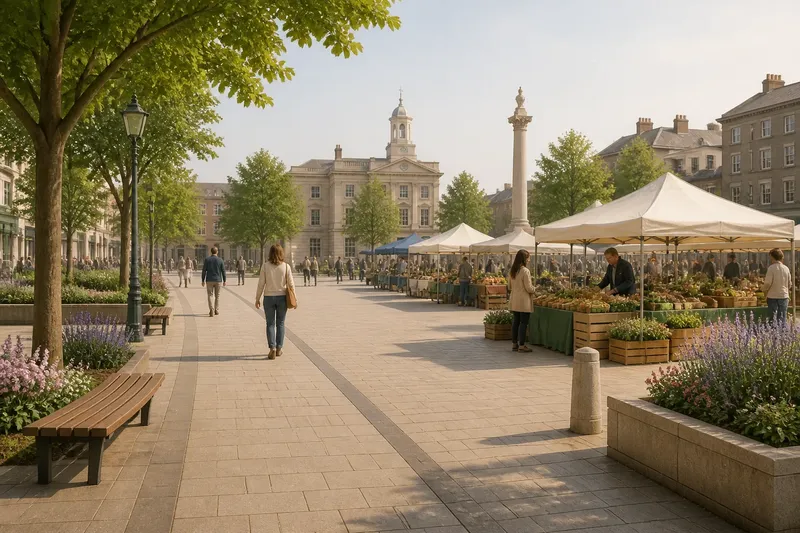
Watch where the ceremony happens, not only what happens at its centre. A route between a civic building and a memorial can make movement part of the event. A group gathered in a semicircle may be able to see a speaker and one another; rows may direct attention towards a single focal point.
Notice thresholds and distances. Does a participant cross an open area while others remain in place? Is there a clear route for a procession, and do people leave that route unobstructed? Does the group form around an object, face towards a building, or turn towards one another? These are practical arrangements as well as visual choices: they affect who can see, hear and take part.
Do not assume that the layout carries a fixed message. A barrier might guide movement, protect an object or leave room for a route. The useful question is what the arrangement enables during this occasion, and how participants respond to it.
What questions help you look more closely?
Should I read the programme before attending?
A programme can name speakers, explain the order and clarify unfamiliar terms, so it is useful when available. Read it as a guide to what may happen, then compare it with the event you can actually observe.
What if I do not understand a gesture?
Note when it occurs and whether others join in before deciding what it means. If the question matters to you, ask an organiser or consult a reliable local explanation afterwards rather than guessing about participants’ beliefs.
Can I take notes or photographs?
Follow signs and organisers’ requests, and be especially considerate during quiet or personal moments. Brief notes about sequence and movement may be less intrusive than photographing people without their agreement.
How can I tell when the formal part is over?
Look for a change in the group’s behaviour: people may begin moving, conversations may resume, or the presiding person may leave the central area. Some attendees will stay, so treat the end as a transition rather than a single instant.
How can you leave with a fair account?
Afterwards, separate what you saw from what you inferred. “The group stood before the address” is an observation; “everyone approved of the address” is a claim about private responses that the scene alone cannot support. This distinction makes your account clearer without stripping the occasion of meaning.
You can also ask what remains uncertain. Perhaps the order was clear but the reason for a particular route was not. Perhaps a gesture was shared by some people and not others. Naming that limit is more useful than filling it with a confident guess.
A civic ceremony is easiest to follow when you give it time to unfold: watch the sequence, notice what recurs, and see how the space guides participation. If you want a small plan for looking at a civic ceremony, begin with one transition and follow where it leads. That single thread can reveal how the occasion holds a community together without requiring you to decode every symbol.